
Embryogenesis
Embryogenesis is complete within 24 hours after fertilization.
The syncytial blastoderm forms due to the movement of nuclei to the edges of the embryo (one cytoplasm with many nuclei, enabling proteins to diffuse throughout the embryo, which is highly important in the development of Drosophila). The antero-posterior and dorso-ventral axes of the embryo are set up by the actions of many different genes.
Maternal genes
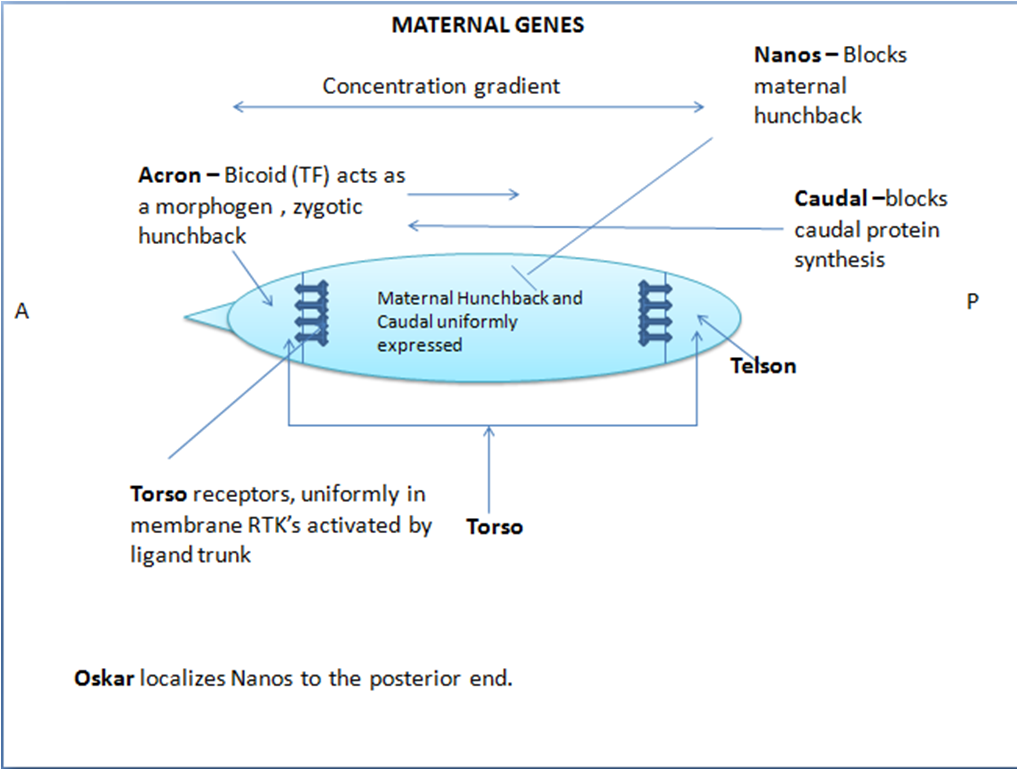
Maternal genes are genes present in the egg before fertilization occurs. Maternal messenger RNA is made by the female Drosophila during oogenesis but is translated only after fertilization. Maternal gene products are responsible for the formation of the dorso-ventral axis and the antero-posterior by affecting zygotic genes.
The antero-posterior axis
An example of a maternal gene product is the morphogen, Bicoid. Bicoid is present in the anterior portion of the unfertilized egg, when translated it diffuses towards the posterior end, forming a concentration gradient along the antero-posterior axis. The highest concentration is at the anterior end and lowest at the posterior. Specific zygotic genes are activated, depending on the concentration of Bicoid.
Caudal is a maternal gene dispersed evenly throughout the egg before fertilization. However, when bicoid messenger RNA is translated, it causes Caudal protein synthesis to be prevented. This creates another concentration gradient, as there is no Caudal protein present in the anterior region of the embryo. Therefore Caudal is highest where Bicoid is lowest.
Nanos is another maternal gene, found in the posterior region of the unfertilized egg. A concentration gradient from posterior to anterior is formed by nanos, with the highest concentration being at the posterior end. Nanos protein acts by suppressing the translation of maternal hunchback messenger RNA, which is evenly spread throughout the egg.
Torso is a maternal gene, which encodes a receptor called Torso. When translated, the receptors are found evenly throughout the egg. Its ligand is a fragment produced by the enzymatic breakdown of a protein named Trunk and is present in the unfertilized egg. However, it is only released after fertilization, when it can then activate Torso. The Trunk fragment, unlike its receptor, is only present in the terminal regions of the embryo.
The dorso-ventral axis
The dorso-ventral axis is formed at roughly the same time as the antero-posterior axis but is determined by different maternal genes to the antero-posterior axis. Dorsal is a protein made by the maternal gene, dorsal. Toll is the receptor, which enables entry of Dorsal into the nuclei when activated by its ligand Spatzle. In the absence of Toll, Dorsal binds to a maternal gene product named Cactus. Cactus is broken down when Spatzle binds to Toll, which allows Dorsal to enter the nuclei resulting in the highest Dorsal concentration being found in ventral nuclei and lowest in the dorsal nuclei. More information regarding the formation of the dorso-ventral axis can be found on the wolpert online resource centre.